Once your books are reliable and your reports fit the business, a different question comes into view: What should you look for each month?
Financial reports should do more than tell you whether the month ended with a profit. They should help you notice meaningful changes and understand where to ask follow-up questions.
The starting point still matters. If the records behind the reports cannot be trusted, interpretation becomes shaky. Reliable bookkeeping and regular review are the foundation. And as we discussed in Accurate Books Are Only the Beginning, a report needs to be timely and structured in a way that fits your business.
The goal is not to watch every possible metric. It is to have a regular conversation about the few numbers that reveal what deserves attention.
Start with change, not a single month's total
A monthly profit number has context only when you compare it with something useful: the prior month, the same point last year, a year-to-date pattern, or a plan you have already established. The right comparison depends on the business. A seasonal practice may learn very little from a straight month-to-month comparison, while a growing service firm may want to see whether payroll, contractor costs, or overhead are rising alongside revenue.
The question is not simply, “Did revenue go up?” It is, “What changed, compared with the period that tells us the most?”
The IRS notes that business records are used to prepare financial statements and monitor business progress. Its recordkeeping guidance is tax-focused, but it reinforces the value of seeing changes over time.
Revenue is only useful when you can connect it to the work behind it
Growing revenue is encouraging. It does not always mean the business is more profitable, has more cash available, or is operating with less risk.
For many businesses, the next useful question is what it cost to generate that revenue. If payroll or subcontractor expense rises faster than revenue, for example, the report may be telling you to look more closely at staffing, pricing, service mix, timing, or how costs are being recorded.
That is not a diagnosis from one line item. It is a prompt to understand the story behind the line item. The answer may be a temporary staffing decision, a one-time project, a change in the type of work you are taking on, or a classification issue that should be cleaned up before you draw conclusions.
The exact measures should fit the business. A professional-services firm may care about the relationship between billable work, compensation, and collections. A business with inventory may need a different discussion. The point is not to adopt someone else's dashboard. It is to identify the numbers that show whether the work you are doing is producing the result you expect.
Profit and cash are related, but they are not the same question
One of the most important monthly conversations is whether cash is moving in a way that matches the story on the profit and loss statement.
A business can report a profit while cash feels tight. Customers may not have paid yet. The business may have paid down debt principal, purchased equipment, made owner distributions, caught up on vendor bills, or paid for expenses before related revenue was collected. The reverse can also happen: cash may look healthy for a month because a large customer paid an old invoice, even though current profitability is under pressure.
This is why a bank balance alone is not a management report, and neither is net income alone. Your reports should help you ask what generated or used cash and what obligations are coming due before the next reporting cycle.
Receivables, obligations, and exceptions tell you where pressure may be building
Some of the most useful numbers are not on the bottom line.
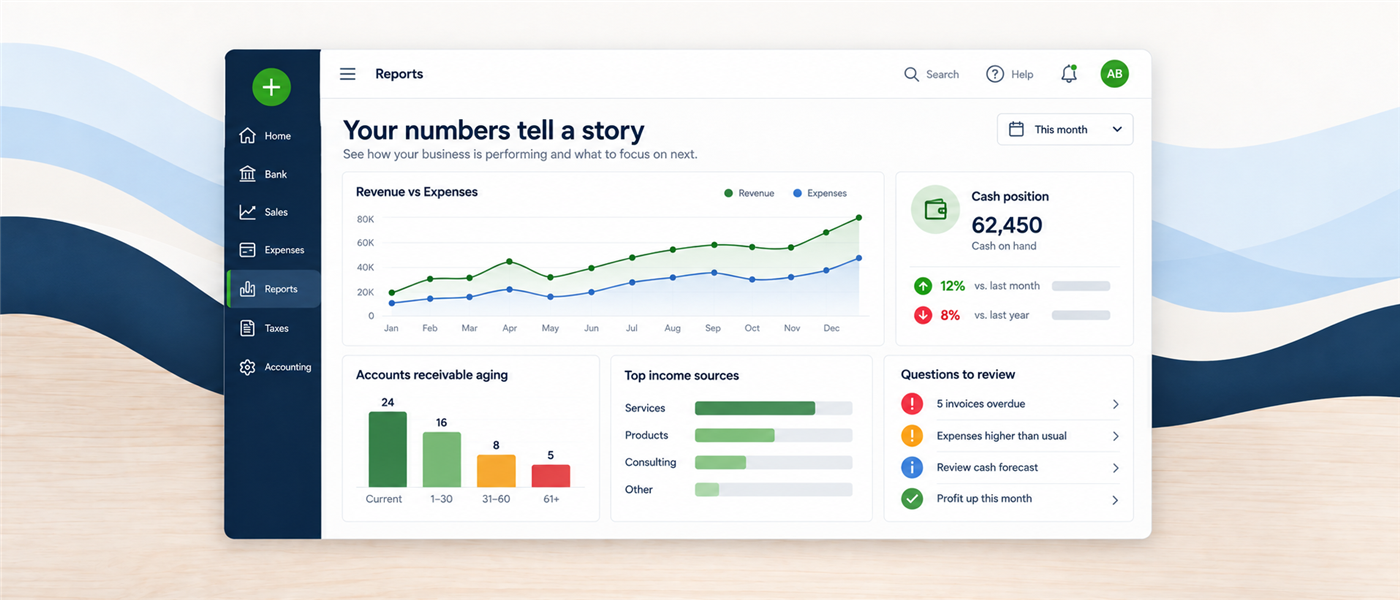
Accounts receivable can show what customers owe you. Looking at aging, rather than only the total, can help you see whether collections are keeping pace with the work completed. Other obligations can show where cash will be needed or where an old item needs explanation.
These balances are not red flags by themselves. A large receivable may reflect a normal billing cycle. A payable balance may be scheduled and expected. But an old, unexplained, or rapidly changing balance deserves a question.
The same is true of unusual activity. A large repair, legal expense, owner-paid item, deposit, refund, or adjustment may be perfectly appropriate. If it is not identified and explained, though, it can distort the trend you are trying to understand. Good reporting makes room for those explanations instead of treating every change as ordinary performance.
The right monthly conversation is specific to your business
There is no universal list of numbers that every owner should track. A short list is useful only if it matches how your business makes money and uses cash.
That is where an ongoing accounting relationship becomes more valuable than receiving statements by email. Your accounting team can help determine what the books can support, compare the periods that matter, and distinguish a question worth pursuing from a number that simply reflects normal timing. The AICPA describes client advisory work as interpreting financial information to help clients make informed decisions.
The discussion should also be honest about its limits. If job costs, service lines, or receivables are not tracked consistently, the first step may be improving the records rather than relying on a polished report. And a monthly discussion is not an audit, assurance opinion, or a substitute for individualized tax, legal, financing, or investment advice.
Questions to bring to your next monthly review
You do not need to become your own CFO to make your financial statements more useful. Start with a few practical questions:
- What changed from the period that gives us the best comparison, and was it expected?
- Is revenue changing because of volume, pricing, timing, service mix, or something else?
- Are payroll, contractor costs, or major operating expenses changing in a way that affects the result?
- Does the movement in cash make sense alongside reported profit, collections, bills, debt payments, and owner activity?
- Which receivables, obligations, or unusual balances need an explanation or follow-up?
The goal is not a perfect answer to every question each month. It is a consistent process for noticing what matters before it becomes urgent.
Move from seeing the numbers to understanding the story
Reliable, useful reports should give you more than totals. They should reveal patterns, tradeoffs, and questions about the way the business is performing. Over time, that discussion helps you focus on what deserves attention and what can be treated as ordinary timing.
At Woodard & Associates CPA, we help business owners connect bookkeeping and reporting with the conversations needed to understand their financial picture. If your reports arrive but do not clearly show what to pay attention to, we can discuss whether the information and review process match the decisions you are making.
Once you know what the numbers are showing, the next question is why the business is performing that way.